

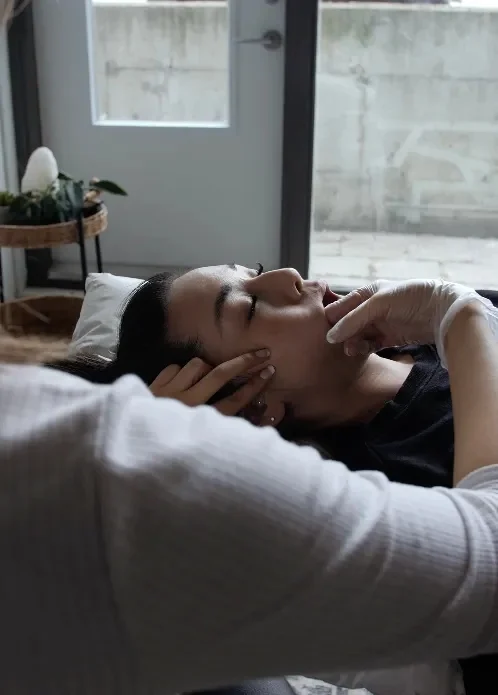
Jaw clicking on its own, with no pain and normal opening, is common and often harmless. It’s worth seeing a physiotherapist when the click comes with pain, stiffness, locking, headaches or trouble opening your mouth, or when it’s getting worse. These are signs of a temporomandibular joint (TMJ) disorder, and physiotherapy is a first-line treatment.
Why does my jaw click?
Your jaw joint, the TMJ, sits just in front of each ear. A small disc of cartilage cushions the joint and glides forward as you open your mouth. A click or pop usually means the disc and the joint aren’t moving together smoothly. Common reasons include:
- tight, overworked chewing muscles from clenching or grinding
- forward head posture, which changes how the jaw sits and moves
- stress, which often shows up as daytime clenching
- a past injury, dental work or long periods with your mouth open wide
- joint hypermobility, where the jaw opens a little too far
When jaw clicking is usually OK
If your jaw clicks but it doesn’t hurt, you can open your mouth fully, and nothing has changed in months, it often doesn’t need treatment. Keep an eye on it, and avoid forcing it wide open to make it click.
Signs it’s time to see a physio
Book an assessment if your clicking comes with any of these:
- pain in your jaw, face, temples or in front of your ear
- pain or tiredness when chewing, talking or yawning
- morning jaw stiffness or soreness
- your jaw catching, locking or opening to one side
- trouble opening your mouth fully
- headaches at your temples, or neck and shoulder tension
- clicking that has become louder, more frequent or newly painful
Earlier treatment is usually easier. Muscles and joint mechanics tend to respond faster before habits like clenching have been in place for years.
When to see a doctor or dentist instead
See a doctor, dentist or urgent care first if your jaw is locked open and won’t close, if symptoms started after a fall or blow to the face, or if you have swelling, fever, numbness, a sudden change in your bite, or pain that is severe or getting worse quickly. A physiotherapist will also refer you on if your assessment shows something that needs another professional.
How physiotherapy helps jaw clicking
At Revival Physio, a jaw (TMJ) assessment looks at your jaw movement plus your neck, head posture, breathing and clenching habits, because jaw problems rarely start in the jaw alone. Treatment can include:
- intra-oral release: gloved, hands-on work on the deep chewing muscles from inside the mouth
- joint mobilization to restore smooth, comfortable opening
- dry needling and acupuncture for tight, painful jaw and neck muscles
- posture and neck work to take load off the jaw
- a short home program of jaw exercises and habit strategies for clenching and grinding
The goal isn’t always to make every click disappear. It’s to get you chewing, talking and opening comfortably, and to stop symptoms from coming back.
What you can try at home
- Rest your jaw: lips together, teeth apart, tongue resting on the roof of your mouth.
- Notice daytime clenching, especially at your desk, while driving or on your phone.
- Choose softer foods and cut food into smaller bites during a flare-up.
- Avoid gum chewing, nail biting and very wide yawns.
- Check your posture: bring your head back over your shoulders rather than forward.
If these don’t settle things within a couple of weeks, it’s time for an assessment.
Do I need a referral, and is it covered?
No referral is needed. In Ontario you can book a physiotherapist directly. Jaw (TMJ) physiotherapy is billed as physiotherapy, so it’s covered by most extended health plans that include physio. If you already see a dentist or orthodontist, we’re happy to coordinate with them.
If your jaw clicks, hurts or feels stuck, Jaw (TMJ) physiotherapy at our Leaside clinic is a good place to start.